Founders are usually asked how much money they want to raise.
I think the earlier question is more important:
What proof should the money buy?
The amount, instrument, investor and timing should follow from the risk being financed. When they do not, the company can appear well funded while becoming structurally weaker.
A grant can be valuable money and still be wrong for an urgent commercial iteration. Venture equity can be flexible and still be expensive for an asset with contracted cash flow. Customer funding can validate demand and still trap a startup in bespoke work. Project finance can lower dilution and still be unavailable before performance becomes bankable.
Capital is not one substance sold at different prices. Different forms of capital are built to tolerate different uncertainties and receive returns in different ways.
The company needs a capital path, not merely a fundraising target.
Begin with the risk
Chapter 8 named the death variable. That creates a sequence:
The risk tells the company what must be learned.
The proof defines the evidence required.
The instrument determines who can rationally finance that work.
The re-rating describes how success changes the company's value, financing options or buyer acceptance.
Starting with the instrument reverses the logic.
“We should raise venture capital” is not a financing strategy unless venture equity is suited to the uncertainty and the expected value created. “We should apply for grants” is not a strategy unless the grant can finance the experiment on the required timeline without distorting the product. “The customer should pay” is not a strategy unless the customer captures enough benefit and does not demand ownership of the reusable learning.
The capital source has to fit the risk and preserve the company the founder is trying to build.
What different forms of capital can bear
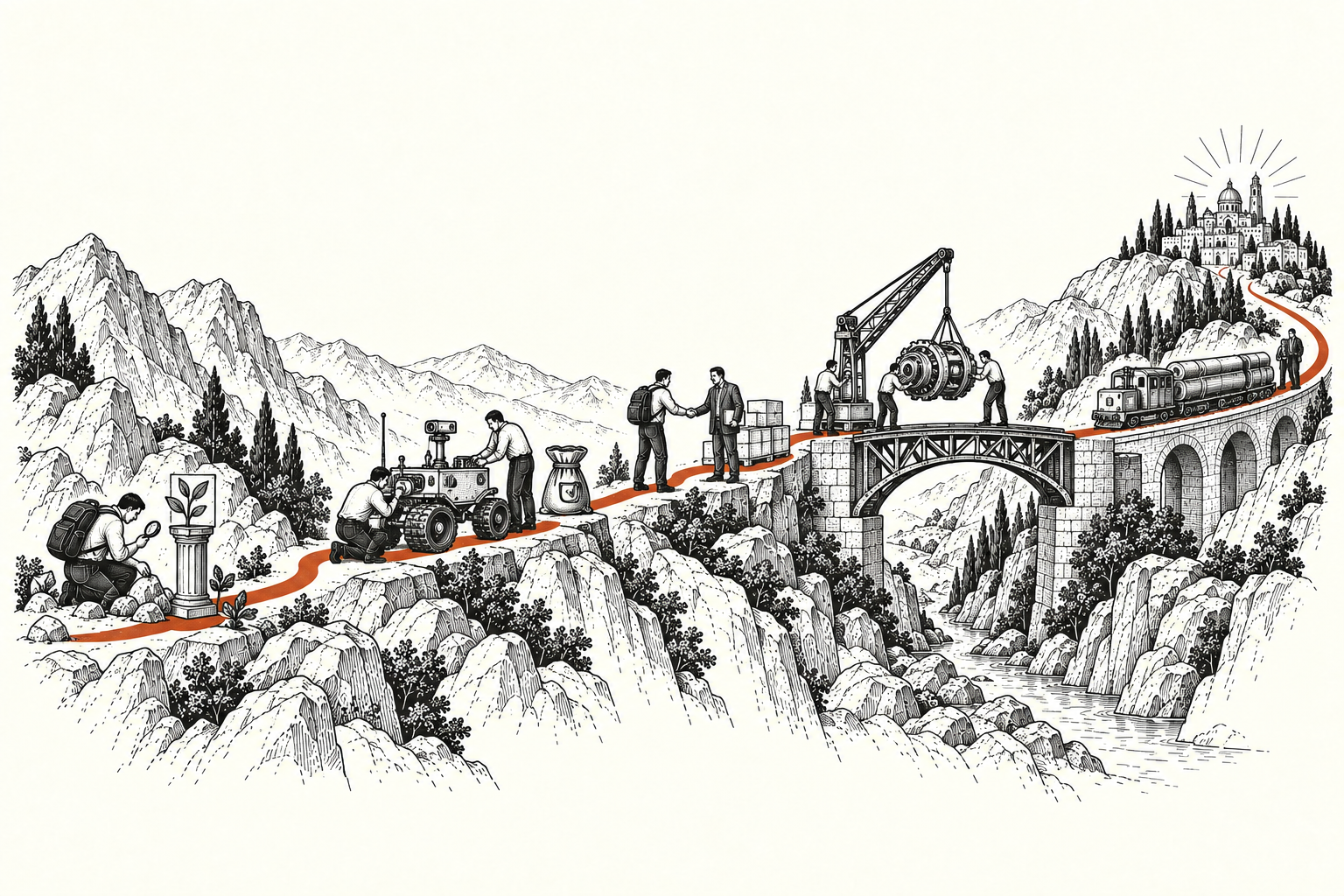
The following map is a starting point, not a universal rule.
Founder and internal capital
Founder savings, early revenue and retained earnings offer control and speed when the experiment is small enough.
This capital is valuable for establishing the first claim, building insight and avoiding premature financing. Its limit is obvious: deeptech experiments can exceed what founders or early customers can reasonably fund, and undercapitalisation can be as destructive as dilution.
Grants and public research support
Grants can bear scientific uncertainty, prototype learning and infrastructure that creates public spillovers. They are especially useful when knowledge may be valuable even if the company does not capture all of it.
But grants have design constraints:
• Application and disbursement timelines.
• Eligible-cost restrictions.
• Reporting requirements.
• Milestones that may not match commercial learning.
• Limited support for customer acquisition or working capital.
A grant can establish that an experiment is worth running. It does not automatically establish a venture-scale company or customer demand.
Venture equity
Venture equity can finance company-level uncertainty when the successful outcome creates reusable product, platform or market value capable of producing power-law returns.
It is appropriate when:
• The company needs flexibility to iterate.
• The asset created belongs to the company rather than one project.
• Success can open a much larger market or product family.
• Cash flows are too uncertain for debt.
• The next proof can materially re-rate the company.
Equity becomes a poor fit when it repeatedly finances low-return physical assets, one-off customer work or predictable project deployment without creating additional company-level advantage.
The distinction is not hardware versus software. It is whether the capital is building a reusable company asset or merely funding an individual installation.
Strategic capital
A corporate or industry investor can bring more than money:
• Domain knowledge.
• Qualification support.
• Supply-chain access.
• Manufacturing capability.
• Customer credibility.
• Distribution.
• A path to an initial deployment.
These benefits can be decisive. They can also create constraints through exclusivity, information rights, channel conflict, acquisition expectations or a roadmap shaped around one strategic partner.
The founder should ask what the strategic investor will help prove—and what future options the relationship might close.
Customer capital
Paid pilots, non-recurring engineering, prepayments, development contracts and offtake can finance qualification while revealing genuine willingness to act.
Customer capital is powerful because it connects money to a real problem. It can also disguise custom development as product progress.
The test is whether the work produces transferable assets:
• Reusable product architecture.
• Qualification history recognised elsewhere.
• Manufacturing learning.
• Reference data.
• A standard interface.
• Repeatable commercial terms.
If every customer pays for a different company to be built, revenue may increase while the product moves backwards.
Debt, equipment finance and project finance
Debt requires a credible source of repayment.
Equipment finance can fund identifiable assets with recoverable value. Project finance can fund deployments whose cash flows, contracts and performance risks can be separated from the startup's general corporate risk. Guarantees, insurance, leases and special-purpose structures may help allocate risk among parties able to bear it.
These instruments become more available after technical and demand uncertainty have been reduced.
Using venture equity for every commercial plant, fleet or installation can produce severe dilution and a return profile mismatched with venture capital. But attempting debt before the technology, contracts or performance are bankable can endanger the company.
The point is not that project finance is cheaper. It is that repeat assets with contracted cash flows are a different object from uncertain company-level research.
Hybrid capital is normal
Deeptech milestones often require several instruments.
A single stage might combine:
• Grant support for an unresolved scientific question.
• Equity for the team and reusable product architecture.
• Customer funding for qualification work.
• Strategic support for manufacturing or supply.
• Asset finance for equipment.
The instruments should remain analytically separate even when they arrive together.
This matters because ecosystems often report grants, equity, debt, project capex, customer contracts, programme ceilings and acquisition proceeds as though they were comparable “funding.” They are not.
A grant ceiling is not cash received.
A memorandum of understanding is not revenue.
Project capex is not automatically startup capital.
Debt is not equity.
An order value is not gross margin.
The company needs to know which balance sheet holds the money, which risk it bears and what obligation it creates.
Match capital to the Acceptance Ladder
The Acceptance Ladder from Chapter 7 provides a useful financing map.
Physics
Likely needs: founder capital, research funding, grants, university or laboratory support and highly risk-tolerant pre-seed equity.
The proof is that the underlying claim works reproducibly.
Relevant environment
Likely needs: seed equity, grants, strategic technical support and design-partner contributions.
The proof is that the capability survives the conditions that matter.
Qualification
Likely needs: equity plus customer, procurement or strategic capital.
The proof is accepted by the authority able to change the purchase decision.
Repeatability
Likely needs: growth equity, customer working capital, equipment finance and strategic supply-chain support.
The proof is repeated manufacturing, deployment and demand.
Economics and deployment
Likely needs: a mix of corporate capital, debt, leasing, project finance, customer capex or growth equity depending on where cash flows and asset risk sit.
The proof is that the delivered system produces attractive economics without consuming structurally unsuitable capital.
These are tendencies, not laws. A customer may fund early research. A grant may support qualification. Venture equity may rationally finance a capital-intensive asset if ownership creates an unusually valuable platform. The map exists to force the question, not predetermine the answer.
Fundraising is a proof sequence
Founders often narrate fundraising as a sequence of company sizes:
The labels describe transactions. They do not describe progress.
For deeptech, the more useful sequence is:
→ decisive technical proof
→ relevant-environment evidence
→ qualification
→ repeat deployment
→ attractive economics
Each round should purchase a proof that changes who can rationally participate next.
A scientific result may make specialist seed investors comfortable. Relevant-environment evidence may bring strategic partners. Qualification may make customers willing to prepay or procurement programmes able to contract. Repeatability may make growth investors and lenders interested. Contracted deployment economics may allow project capital.
The round is successful when it expands the company's set of credible next financiers without weakening its strategic position.
The re-rating event
Not every milestone changes the company's value equally.
A re-rating event removes an uncertainty important enough to change the investor's or buyer's model.
Examples might include:
• A result in the relevant operating environment.
• Acceptance by a recognised qualification authority.
• A design-in that is difficult to reverse.
• A repeat order after real use.
• Manufacturing yield sustained across batches.
• Performance and service costs demonstrated at the customer's boundary.
• A contract that makes project cash flows financeable.
The company should be able to explain why the next proof changes more than the slide deck.
If the milestone does not change the perceived probability, scale, timing or capital intensity of the outcome, it may not justify a meaningful re-rating.
The wrong capital changes the company
Capital is not neutral.
Its timelines, return requirements, governance and conditions can reshape company strategy.
Short-duration capital can force premature commercial claims. A large strategic cheque can pull the roadmap toward one partner. Customer funding can turn a product company into a services company. Grant dependence can optimise the organisation for applications and reporting. Equity can make a slow, asset-heavy model appear viable until repeated rounds become impossible. Debt can make a temporary technical delay existential.
The correct question is therefore not only “Can we get this money?”
It is:
What behaviour will this capital cause, and is that behaviour compatible with the company we want to build?
Financing the company, asset and customer separately
Many deeptech businesses contain several economic objects that should not be financed identically.
There may be:
1. A technology company creating intellectual property and product architecture.
2. A manufacturing asset producing physical output.
3. A deployment project serving an individual customer.
4. A customer who may require financing to adopt the system.
If all four sit on the startup's balance sheet, ordinary venture equity carries every risk simultaneously.
Separating them is not always possible or desirable, especially early. But the founder should at least know which risk belongs where. Corporate equity should fund reusable company advantage. Asset and project structures should increasingly finance repeat physical deployment once performance and cash flows are credible. Customer finance may be necessary when adoption creates value over time rather than immediately.
Capital architecture becomes part of product architecture.
The financing narrative
A clear deeptech fundraising narrative can be organised around five statements:
1. The outcome: what the buyer needs to become true.
2. The owned layer: what the company controls and why it captures value.
3. The current gate: what has already been proved.
4. The death variable: what remains decisive.
5. The use of capital: which evidence this round will produce and what it unlocks.
This is more credible than presenting a long activity plan and asking the investor to infer why the activities matter.
The budget should map to the proof. The runway should extend beyond the proof far enough to absorb normal delay and finance the next decision. The round size should reflect the cost of reaching a buyer-legible result, not only the company's preferred dilution.
What the round should leave behind
When the capital is spent, the company should be different in a durable way.
It should know, own, control or be trusted to do something it could not do before.
The result might be:
• A scientific option converted into a product claim.
• A death variable retired.
• A qualification accepted.
• A production process repeated.
• A customer relationship converted into repeat demand.
• An asset made financeable without more corporate equity.
• A first product that makes the next product easier to build.
Runway measures time purchased.
Proof measures uncertainty removed.
The company needs both, but only the second changes the underlying investment.
Questions I now ask
1. Which risk is this capital financing?
2. What exact evidence should exist when the money is spent?
3. Who will accept that evidence?
4. How will success change the next financing option?
5. Is the capital building a reusable company asset or one deployment?
6. Which part belongs to grants, equity, customers, strategics, debt or project finance?
7. What conditions or incentives arrive with the money?
8. Will customer funding produce a reusable product or bespoke work?
9. Can asset and project risk eventually leave the corporate balance sheet?
10. Does the runway extend beyond the proof to the next financing decision?
The fundraising question is not simply how much capital the company can attract.
It is whether the company can assemble a sequence of capital that buys the right evidence without giving away the learning, control or economics it is trying to build.
Capital should follow the risk.
And every round should buy proof.