I used to draw the path from an idea to a company as a straight line:
The drawing remains useful. Research discovers something new. Technology turns the discovery into a repeatable capability. Product makes the capability usable and buyable. Distribution puts the product in front of customers.
But the straight line hides the most important part.
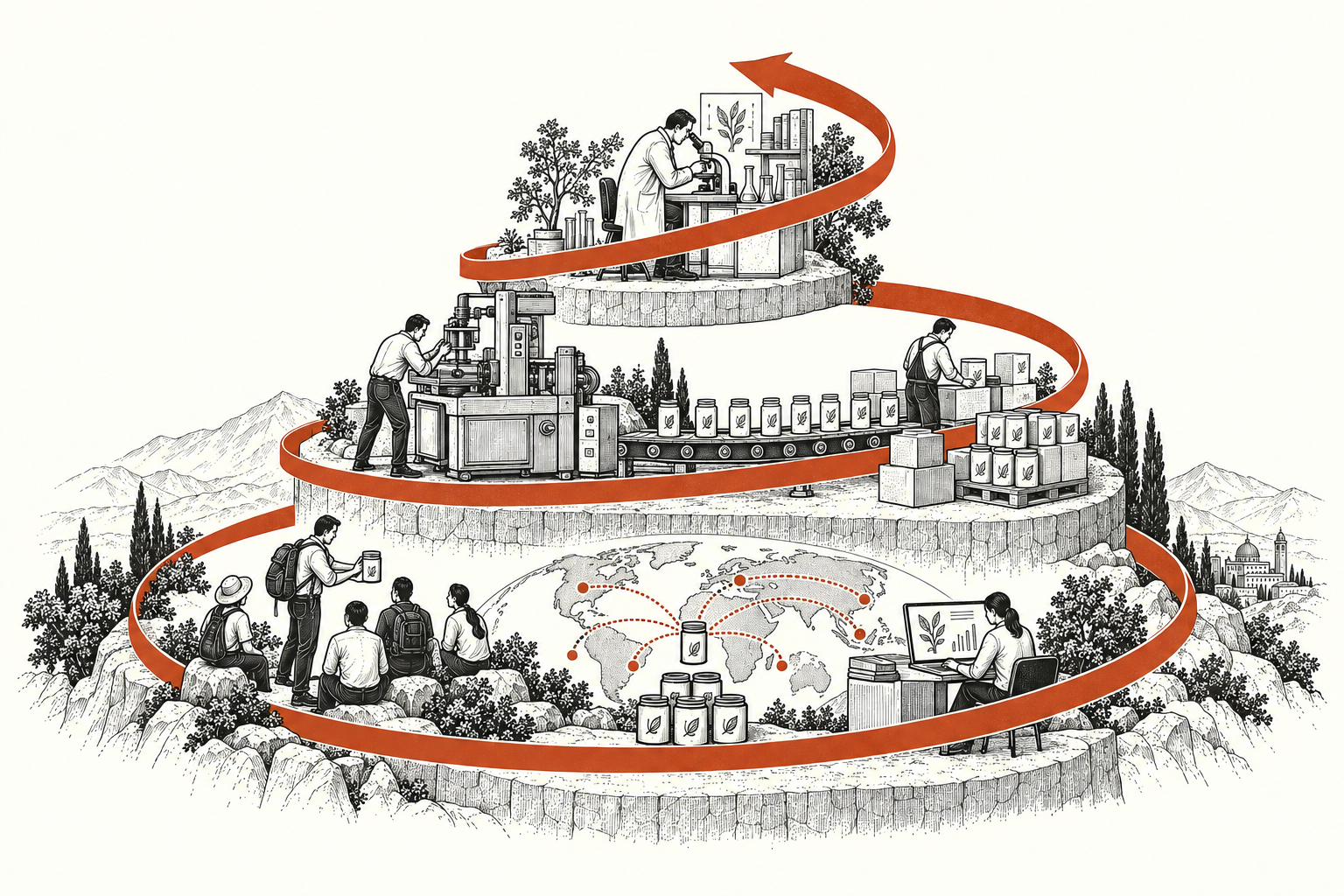
The better company does not reach distribution and stop. What happens in the market returns upstream. Buyers reveal what they actually value. Deployment exposes failure modes that laboratory testing missed. Manufacturing reveals which performance claims survive at acceptable yield. Service reveals which complexity the customer can tolerate. Distribution reveals not only who wants the product, but what the company has earned permission to build next.
So the more accurate drawing is:
↑ │
└────── evidence, trust and cash ──┘
I think of this as the compounding stack.
The company becomes stronger when each layer improves the others—and when each product generation leaves behind capabilities that make the next product easier to build.
The first product leaves a residue
A product is normally evaluated through revenue, growth, margin or market share. These are necessary measures, but they do not capture everything the product creates inside the company.
After a product has been built, qualified, sold and supported, what remains?
Possibly:
• A manufacturing process the company now understands.
• A supply chain willing to work with it.
• Field-performance data competitors do not possess.
• A qualification history accepted by an important buyer.
• A service team that understands real operating conditions.
• Distribution into a difficult market.
• Brand and trust with a particular kind of customer.
• Cash flow that can finance deeper technology.
• An interface or platform on which other products can be built.
These assets may be more important than the revenue from the first product. They determine whether the company has merely completed a transaction or increased its capacity to create future products.
This changes the question I ask about an initial market.
The obvious question is: How large can this product become?
The additional question is: What will this product teach the company, and what will it allow the company to do next?
The best first market is not always the largest immediate market. It may be the market that produces the right operating data, qualification history, manufacturing discipline or customer relationship for a much larger second act.
Apple did not begin the iPhone with the iPhone
The transition from the iPod to the iPhone is a useful way to see this.
It would be wrong to describe the iPod as a product without meaningful research or technology. Its hardware, software, storage, battery, interface and industrial design required serious engineering. Apple also brought capabilities from the Macintosh that predated it.
But the iPod and iTunes era left Apple with something larger than a successful music player.
It strengthened Apple's ability to design portable consumer hardware, coordinate a demanding supply chain, connect hardware and software, manage content relationships, distribute directly to consumers and make complicated technology feel simple. It expanded the company's retail presence, brand permission and installed base.
Those capabilities did not automatically produce the iPhone. But they changed which product Apple was capable of attempting.
The iPhone then added harder layers: touch interaction, mobile computing, communications, a more capable operating system and eventually an application ecosystem. The product deepened Apple's technology while dramatically expanding its distribution.
That distribution reinforced the product. A larger installed base attracted developers. More applications made the device more useful. Greater usefulness expanded the installed base. Revenue and strategic importance allowed Apple to move further upstream into core technologies, including greater control over silicon.
The sequence was not simply:
It was closer to:
→ accumulated capabilities
→ permission to attempt a harder product
→ Product 2
→ greater distribution and cash flow
→ deeper technology
→ a stronger Product 3
Each product changed the company that would build the next one.
Companies can enter the stack from different places
Not every company begins with research.
Research-first companies
These begin with a scientific or engineering asymmetry and move towards a repeatable technology, then a complete product and finally distribution.
Their risk is disconnection. They may optimise what is technically interesting rather than what changes a buyer's outcome. If the feedback loop closes slowly, several years of research can accumulate before the company discovers that it solved the wrong version of the problem.
Product-first companies
These begin with a clear product or experience and initially assemble available technologies underneath it. As they learn what limits performance, cost or defensibility, they may move upstream into proprietary technology and research.
Their risk is shallowness. If the underlying capability remains easily available to competitors, product insight and execution may not create durable control.
Distribution-first companies
These begin with customer access, demand aggregation or a trusted relationship. Their distribution reveals unmet needs and can support a move upstream into products and technology.
Their risk is becoming a reseller. Access without differentiated capability can create volume without durable value capture.
None of these starting points is inherently superior. The important question is whether the company uses its starting advantage to strengthen adjacent layers.
Forward and backward movement
A research-first company normally moves forward:
A distribution-first company may move backwards:
A product-first company may move in both directions:
These movements are forms of strategic deepening. The company uses strength in one layer to gain control over a neighbouring bottleneck.
But deeper is not automatically better.
Vertical integration can improve learning and value capture. It can also burden a company with factories, channels, services or research programmes it is not equipped to manage. A startup can exhaust itself trying to own the entire stack before it has earned a reason to do so.
The principle is therefore not “own everything.”
It is:
Own the learning loop, not necessarily every operation.
A company may use manufacturing partners and still retain process knowledge. It may use distributors and still maintain direct access to customer feedback. It may license research while owning the product architecture and qualification history. It may partner for service while ensuring that field failures return to the team designing the next version.
The operating activity can sit outside the company. The learning cannot disappear with it.
When the stack fails to compound
The stack looks complete from the outside when a company has technology, a product and customers. But it may still fail to compound.
A one-off engineering project can generate revenue while leaving behind little reusable product knowledge. A distributor can own the customer relationship and prevent the manufacturer from understanding why buyers choose or reject the product. A contract manufacturer can accumulate the process learning while the nominal technology owner becomes dependent on it. A pilot can produce publicity without producing a qualification record that transfers to the next customer.
The test is whether the evidence travels.
Does the first deployment make the second deployment cheaper, faster or more probable? Does every unit manufactured improve yield? Does qualification with one buyer reduce the burden with another? Does field data improve the underlying model or product? Does the customer relationship reveal an adjacent problem the company is unusually prepared to solve?
If the answer is no, the company may be repeating work rather than compounding it.
The deeptech product ladder
This is particularly important in deeptech because product cycles are long and capital is expensive.
Consider a company beginning with a specialised sensing component. Its first product may leave behind:
• A repeatable fabrication process.
• Environmental-performance data.
• Qualification with a demanding customer.
• Understanding of installation and calibration.
• A service relationship with operators.
• Data from the environment in which the sensor is used.
Those assets might support a second sensing product. Several products might then support an integrated sensing system. The integrated system might generate workflow data and create a decision product. Eventually, the company may control enough of the outcome to become a complete mission system.
The movement could look like:
→ qualified product
→ product family
→ integrated system
→ complete customer outcome
→ platform
This path is not inevitable, and it is not always desirable. The sensing component may be sufficiently indispensable and defensible that remaining an enabling layer produces the better company. But the sequence makes the strategic choice visible.
The company that begins by arming David may accumulate enough product, customer and distribution capability to become David. A complete-system company may discover that one of its internal technologies is valuable enough to become a platform that arms many other challengers.
Be David or arm David describes a strategic position, not a permanent identity.
What capital should leave behind
This also changes how I think about fundraising.
Capital should not merely keep the company operating until the next round. It should leave behind an asset that changes what the company can do or who can rationally finance it next.
Research capital should create a technical option. Seed capital should retire a death variable. Qualification capital should create buyer-legible evidence. Manufacturing capital should produce repeatability or yield. Growth capital should expand a distribution system that becomes more efficient with use.
The strongest milestone is not an activity completed. It is a capability accumulated.
That gives founders a more demanding way to plan a round:
When this money is spent, what will the company know, own, control or be trusted to do that it cannot do today?
Questions I now ask
When I evaluate a first product or market, I ask:
1. Which capability will remain after the first sale?
2. What proprietary evidence will deployment generate?
3. Who owns the customer relationship and the resulting feedback?
4. Does the first product make the second cheaper, faster or more probable?
5. Which neighbouring layer is currently constraining the company?
6. Should that layer be owned, controlled through contract or left to a partner?
7. Could the company move from enabling a challenger to becoming one?
8. Could an internal capability become a platform for other challengers?
9. Is the company compounding reusable assets or repeating bespoke work?
10. What will the current round of capital permanently leave behind?
A great product creates value for a customer. A compounding product also changes the company that produced it.
That is why the path from research to distribution should not be understood only as a pipeline. It is a system for accumulating capability. The company becomes powerful when the product it sells today makes the product it wants to build tomorrow less speculative.